Quick Answer:
Yes. Vinyl privacy fencing is a reliable residential screening option, widely used across South Jersey.
The material alone does not guarantee the outcome. A fence can look fully private on day one and still develop gaps if the panel type, height, or installation is mismatched to the site. Those three variables determine what you actually get.


Each board slots into the groove of the board next to it. The interlocking profile leaves no air gap between boards. From the bottom rail to the top rail, the panel face is a continuous surface.
Tongue-and-groove vinyl panels interlock mechanically — no adhesives, no brackets. The profiles are machined to tight tolerances, which keep the interlock closed across the full panel length.
Shadowbox Looks Solid Straight-On. It Is Not.
Tri-State Field Notes: Shadowbox vs. Full Privacy Panel
Shadowbox alternates boards on opposite sides of the center rail. Head-on it appears solid. Step to the side, or stand at close range, and the offset creates visible gaps. From inside the yard, those gaps are noticeable. This is the most common pre-installation misunderstanding we see. A homeowner points to a neighbor's shadowbox and asks for the same thing, not realizing it is not a full privacy fence. Clarify panel type before ordering.
Shadowbox works well in many situations. It handles wind load better than a solid panel and suits HOA communities that allow decorative fencing.
See every vinyl fence style and what each one delivers for privacy
Most privacy complaints we hear come down to sightlines above the fence, not gaps in the fence itself.
A 4-foot solid panel has no gaps but does not screen a standing adult. A 6-foot shadowbox covers more of the view but has gaps. The combination that delivers full privacy for most rear and side yards across Gloucester, Camden, and Burlington counties is a 6-foot solid panel.
Homeowners on busier roads — Route 130 in Cinnaminson, Hurffville Road in Washington Township, Route 73 in Voorhees — sometimes ask about 8-foot panels for added buffer.
A solid 6-foot vinyl panel blocks sight lines. It does not meaningfully reduce noise.Standard residential tongue-and-groove PVC panels are not designed as acoustic barriers and carry no sound transmission ratings. Some specialty or high-density fence products have been tested under ASTM E90, but a standard residential vinyl privacy fence is not one of them. You may notice a slight noise reduction directly at the fence face — a windbreak effect, not acoustic insulation.
If Traffic Noise Is Your Primary Goal:
A vinyl fence will not solve a noise problem near Route 42, Route 130, or the Atlantic City Expressway corridor. Acoustic barriers, dense landscaping, or berms are different products built for that purpose. We cover this at the estimate stage so homeowners with noise concerns can weigh their options before committing to a material.


Larger residential lots in Harrison Township, Mullica Hill, and parts of Burlington County often have terrain grade that requires a design decision before the post layout is set.
There are two ways to handle it:
The grade is visible during the site visit and should be factored into the post layout before installation begins.
The Installation Creates the Gap, Not the Material
On otherwise flat ground, gaps at the base still appear when grade is not managed carefully during installation. If the bottom rail is set too high to clear uneven ground, light and sight lines pass underneath. These are not material failures. They are installation decisions. And they are preventable when the layout is planned correctly. Before installation: ask specifically how the crew handles grade management at the bottom rail.
Vinyl panels flex under wind load rather than resisting rigidly. Whether that flex becomes a structural problem depends on post depth, footing quality, and post spacing. Post depth is the variable. Panel behavior follows from it.
On open rear yards in South Harrison, Woolwich, or on exposed Burlington County lots, posts need adequate concrete footings and proper spacing. Shallow posts in poor footing make the flex look like movement. Deep, correctly spaced posts in good footing keep it imperceptible.

Four Property Situations Where Vinyl Consistently Delivers

Homes in Cherry Hill, Voorhees, and Haddonfield often have rear yards 15 to 30 feet from the next structure. A 6-foot solid vinyl panel delivers consistent privacy without the maintenance burden of wood. Those lots are often in HOA communities where the fence line is visible from multiple neighboring properties, and vinyl's consistent appearance holds up across adjoining yards without touch-up work.

Vinyl is a common material choice for residential pool enclosures across South Jersey. The non-porous surface does not absorb water or pool chemicals. Solid vinyl at pool height delivers privacy without drawing attention away from the pool itself. Pool barrier code compliance is covered separately.
For homeowners in Washington Township, Voorhees, or Moorestown, where pool installations are common in newer developments, vinyl also satisfies most HOA material requirements without additional variance requests.
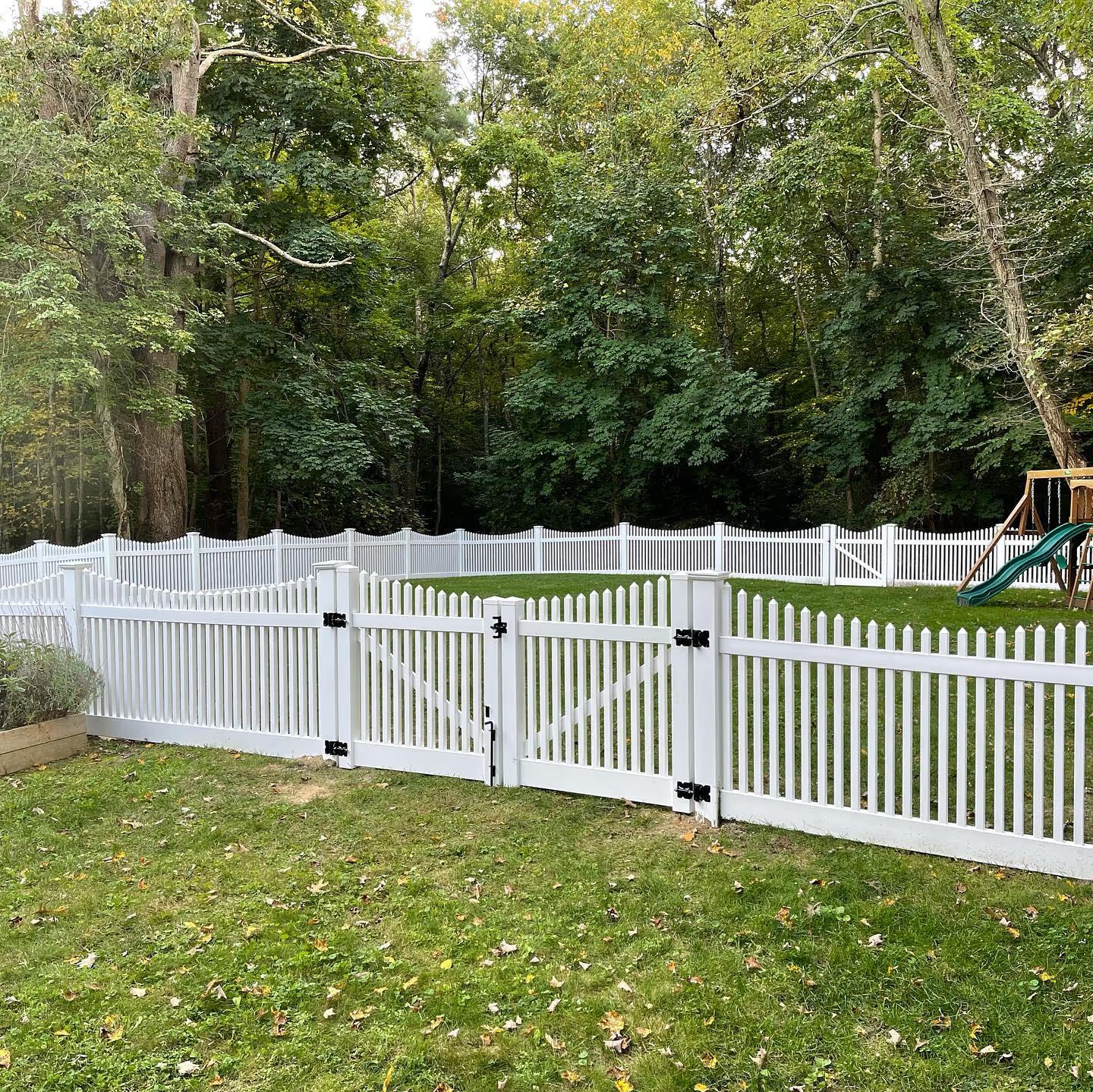
In newer developments in East Greenwich, Moorestown, and parts of Camden County, vinyl often appears on HOA-approved materials lists. White and tan vinyl holds its color without the fading and weathering that requires touch-up on painted wood. The uniform appearance across adjoining properties is part of why HOAs include it on approved materials lists.
If your development has specific color or style requirements, confirm the approved profile before ordering. Some HOAs specify solid panel only and exclude shadowbox or lattice-top variations.
On properties where the side setback between homes is 8 to 12 feet — common in Deptford, Bellmawr, and parts of Pennsauken — solid vinyl on the property line blocks the view without requiring maintenance attention every few years. On very tight lots, vinyl can be set with minimal clearance from the property line.
For side yards adjacent to driveways, specifying a panel with no bottom gap is particularly important. A driveway grade that drops slightly below the fence line can create a gap visible from street level.
What separates vinyl from wood is not day-one performance but what happens in years three, five, and ten.
Wood boards dry and contract across South Jersey's humid summers and cold winters. A wood fence installed five years ago on a South Jersey lot typically has visible daylight between boards by now. The tongue-and-groove interlock on a vinyl panel is held by mechanical fit, not material moisture, so moisture-driven gap formation is not a factor.
One limitation applies: PVC expands and contracts with temperature. Dark-colored vinyl absorbs more heat and moves more than light-colored panels. Correct installation spacing accounts for this. A properly installed vinyl fence handles thermal movement without visible effect. An improperly spaced one can bow or stress at the joints over time. Ask about this during the estimate, especially for darker colors.

A gate with gaps around the frame creates a visible channel at exactly the height where sightlines matter. The hinge-side and latch-side clearances can be large enough to defeat the solid panel next to it. Gate gaps are among the most common post-installation complaints when clearance is not specified up front.
A correctly built gate fills the opening with minimal clearance, uses hardware that keeps the door plumb over time, and matches the panel profile. Specify this at the design stage.
A 6-foot panel with a 6-inch lattice cap is a 5-foot-6-inch privacy fence with a decorative top. The lattice section allows sight lines through the upper portion of the fence face. From inside the yard, that opening is noticeable, particularly from elevated decks or neighboring second-story windows.
For maximum privacy, specify a solid flat-top. If the lattice is aesthetic and the property allows it, add 6 inches to the overall fence height. Decide this before ordering material, not after.
Panel type, height, gate construction, and installation method together determine what your fence actually delivers.
Tri-State Fence and Deck has installed privacy fencing across Gloucester, Camden, and Burlington counties for nearly 20 years. We work through those decisions during the estimate stage so the installed fence matches the outcome you planned.
Serving Gloucester, Camden, and Burlington counties in South Jersey, plus Southeastern Pennsylvania and Northern Delaware. Licensed in NJ (#13VH13604500).
