
If you're planning a new fence anywhere in Chester County, the first real question isn't how tall you can build — it's which township's rules apply to your address. This guide breaks down the fence permit, height, and setback rules for six Chester County townships, plus the HOA, boundary-fence, utility-marking, and pool-barrier requirements that apply no matter where in the county you live.
Chester County spans 73 municipalities, and fence rules are set at the township or borough level, not by the county as a whole. That means a rule that applies in West Goshen Township may not apply three miles away in Tredyffrin Township, and treating one township's ordinance as if it covers the whole county is one of the most common mistakes homeowners run into during the permitting process.
There's no single Chester County fence rules document you can pull up and apply anywhere in the county. Instead, each municipality writes its own zoning code covering permits, maximum height, setbacks, and in some cases the materials allowed in a front yard. Some townships require a permit for any fence at all; others only step in once a fence crosses a certain height. Some cap front-yard height at 3 feet, others at 4 feet, and side and rear yards vary just as much.
This guide walks through six townships we researched directly from their published ordinances: West Goshen, Tredyffrin, East Goshen, Warwick, Downingtown, and Schuylkill. They're meant to be illustrative of how much the rules shift from one municipality to the next, not a complete directory of all 73. Alongside those township breakdowns, we cover the questions that come up regardless of which municipality you're in: how HOA rules interact with township zoning, who's responsible for a boundary fence, when PA 811 notice is legally required, and what Pennsylvania's pool barrier rules actually call for.
Every ordinance citation below came from the township's own published code or zoning document, not a generic contractor blog or aggregator site repeating secondhand numbers. Where a detail couldn't be fully verified against the source, we've flagged it rather than presenting it as settled fact. If you're planning a project, the smart move is still to confirm current numbers with your township directly before you finalize anything. For a broader look at fence types and installation scope beyond permitting, our residential fencing services overview covers the options available to Chester County homeowners.
The six townships below show the range of what's out there, not the full picture for all 73 municipalities in the county. A rule confirmed for West Goshen doesn't necessarily hold two townships over, and ordinances get amended, so always double-check current requirements with your own township office before applying for a permit.
West Goshen's rules are laid out clearly in Ordinance No. 12-2024, an amendment to the township's zoning code addressing fences and walls directly. A zoning permit is required for a fence of any height, no exceptions. Once a fence reaches 8 feet or taller, a building permit is also required under Section 84-67, on top of the zoning permit.
Height and placement rules split by yard and use. In a front yard, fences are capped at 4 feet and must be non-solid, meeting a 1:1 open-to-structural ratio; a fully solid front fence isn't permitted regardless of height. Side and rear yards allow up to 6 feet for residential properties and up to 10 feet for non-residential properties.
Because West Goshen requires a zoning permit for every fence, homeowners in this Chester County township sometimes assume a low decorative fence is exempt. It isn't. West Goshen's fence ordinance is worth reading in full if you're in the township, since it spells out the open-to-structural ratio in more detail than most neighboring codes.
Tredyffrin's fence standards, one of the more detailed codes among Chester County townships, live in Section 208-119 of the township code. Unlike West Goshen, a zoning permit here is only required once a fence exceeds 4 feet, so shorter decorative fencing generally doesn't trigger the permit process. Front yards are capped at 4 feet, and side and rear yards at 6 feet.
Some townships also regulate how far a post or finial can rise above the fence line. We've seen that detail referenced for Tredyffrin but couldn't confirm the exact tolerance against the current code, so confirm that specific point with the township directly if a decorative post or cap is part of your design.
The core height and permit thresholds above are drawn straight from Tredyffrin's fence code section, and they're the numbers most homeowners in the township actually need to plan around.
East Goshen's zoning, like much of Chester County, generally follows a similar shape to its neighbors: front yards are capped at 4 feet with a 1:1 open-to-structural ratio, while side and rear yards allow up to 6 feet for residential lots and up to 8 feet for non-residential lots. The source document we reviewed didn't fully verify every detail word for word, so treat these figures as generally accurate rather than beyond question.
Permit fees are worth double-checking before you budget for a project. We found a figure of reportedly around $150 tied to Resolution 2026-03, but fee schedules change and this one isn't fully confirmed. Call the township directly at 610-692-7171, ext. 3103, to get the current fee and permit requirements before you apply.
East Goshen's own permit requirements page is the best starting point for current forms and contact information.
Warwick Township's fence standards fall under Article 19, Section 1902 of its zoning ordinance, and the front-yard number here is a common misconception among Chester County homeowners. Front yard fences are capped at 3 feet, not the 6 feet many assume applies countywide. Side and rear yards, categorized as "any other yard" under the ordinance, allow up to 6 feet.
These figures are sourced from the township's published zoning ordinance, but given how often this specific front-yard number gets confused with the more common 6-foot limit used elsewhere, it's worth a final manual check with Warwick Township before submitting a permit application based on it. Warwick Township's zoning ordinance is the reference document to review.
Downingtown handles front yards differently than most Chester County townships covered here. Walls and hedges in a front yard are capped at 3 feet, and any front-yard fence needs Borough Council review of both material and character before installation, not just a standard permit sign-off. The borough's stated preference leans toward a white picket look, and chain link is barred outright in front yards.
Side and rear yards are more straightforward: 6 feet for residential properties, and a range of 6 to 10 feet for industrial lots. Rather than pin this rundown to one exact subsection number, it's worth reading the Downingtown's zoning chapter in full, since the borough's review process for front-yard material and character is more involved than a simple height check.
Given Downingtown's stated preference for picket-style fencing, it's the one township in this guide where a traditional wood picket option genuinely fits the borough's own aesthetic guidance rather than being a generic add-on.
Schuylkill Township, another Chester County municipality with its own approach, requires a fence permit, and Section 370-128(C) of its code specifically governs relief for fences that exceed 6 feet, which typically means a variance or special review rather than a standard permit. We've seen a figure floated that street-facing yards must be at least 50 percent open, but that number isn't verified against the current code, so don't treat it as settled.
If your project involves a taller fence or a front yard facing the street, call the township at 610-933-5843 to confirm the open-yard requirement and any relief process before you finalize plans. Schuylkill's own Schuylkill Township permit page is the right starting point for current forms.
If your property sits inside a homeowners association, the township's zoning ordinance isn't the only rulebook you're working with. HOA fence regulations in Chester County sit on top of township requirements, not in place of them. That means a homeowner in an HOA community typically needs both HOA architectural approval and any permit the township itself requires, and skipping either one can hold up a project even after the other is squared away.
Township zoning tends to focus on measurable things: height limits, setbacks, open-to-solid ratios, whether a building permit kicks in above a certain height. HOA covenants often go further, restricting the materials allowed, dictating a specific color or finish, or requiring a uniform style across the whole community so fences look consistent from house to house. A fence that fully satisfies West Goshen's or Tredyffrin's zoning code can still get rejected by an HOA architectural review board if it doesn't match the community's approved style.
The two approval tracks don't always move in the order homeowners expect. Some associations want to see the township permit application before they'll sign off; others want their own approval letter in hand before you submit anything to the township. Getting that sequence wrong is a common reason projects stall for weeks.
This is exactly the kind of coordination problem that gets easier with a contractor who handles both pieces directly, submitting the HOA paperwork and the township permit application as one coordinated process instead of leaving the homeowner to guess which one comes first. If you're weighing a project on an HOA lot anywhere in Chester County, it's worth talking through your specific community's requirements before you commit to a design. You can talk to our team about your specific HOA and township requirements and get a read on both sides of your project at the same time.
Not every HOA enforces its architectural guidelines the same way, and some communities are more particular about fencing than others. Reading your association's governing documents, or calling the management company directly, is worth doing before you settle on a fence style, since a rejected HOA submission after a township permit is approved is a frustrating way to lose time on a project that was otherwise ready to move forward.
There's a common assumption among Chester County homeowners that neighbors automatically split the cost of a fence built on the property line 50/50. In Pennsylvania, that's not how the law actually works for most residential properties. There's no statute requiring residential landowners to share the cost of a boundary fence, and Pennsylvania Superior Court decisions from 1997 and 1999 specifically addressed this, exempting residential landowners from mandatory cost-sharing rules that apply in other contexts.
The older Pennsylvania fence law that does require cost-sharing was written with agricultural use in mind, and it mainly applies to neighbors who keep livestock, where a shared fence serves a functional purpose for both properties. For a typical residential lot in Chester County, that framework generally doesn't apply, and a neighbor can't compel you to pay for half a fence simply because it sits on the shared property line.
Ownership and cost aren't quite the same question, either. A fence built exactly on the boundary line is generally considered jointly owned by both property owners, since it sits on both parcels at once. But joint ownership doesn't automatically mean joint responsibility for maintenance or repair costs. Absent a written agreement between neighbors, one owner generally can't force the other to pay toward upkeep just because the fence straddles the line.
Practically, this means the fairest path is usually a conversation and, ideally, a written agreement with your neighbor before construction starts, laying out who's paying for what and who's responsible for maintenance going forward. Without that agreement, the legal default in Pennsylvania favors the homeowner who builds and pays for the fence, not an assumed cost split.
Yes. Pennsylvania's One Call law, PA 811, requires you to notify the system before any excavation, and setting fence posts counts as excavation under the law, whether the project is in a Chester County township or elsewhere in the state. This applies whether you're digging by hand or with equipment, and it applies to a small residential fence project just as much as a larger one.
The notice window is specific. Under Act 287, as amended by Act 50, you're required to give notice no less than 3 and no more than 10 business days before you start digging. The earliest you're legally allowed to begin excavation is the third business day after you place your ticket, giving utility companies time to mark buried lines on your property.
Tickets aren't good indefinitely. They're valid for a limited window, so check your ticket confirmation for the exact expiration rather than assuming you have unlimited time to start digging once you've called.
Skipping this step isn't just a paperwork risk. Hitting a buried gas, electric, or communication line while setting posts can mean real safety hazards along with repair costs that fall on the homeowner. Before you dig anywhere in Chester County, call PA 811 before digging and give the marking process time to happen. The requirement itself comes from Pennsylvania's official one-call law, which the Public Utility Commission oversees.
If your Chester County project includes a pool, fencing rules get more specific than a standard yard fence. Pennsylvania's Uniform Construction Code adopts the International Swimming Pool and Spa Code by reference, with that adoption effective Jan. 1, 2026. That means pool barrier requirements in Pennsylvania now follow the ISPSC framework rather than a state-specific pool code written from scratch.
Under Pennsylvania's adopted pool and spa code, which applies the same way to a Chester County pool as anywhere else in the state, the general barrier concepts homeowners should expect include a minimum barrier height around the pool, gates that self-latch and self-close, and a barrier designed so a young child can't easily climb or squeeze through it. The exact numbers and technical requirements are detailed in the code itself, and they're specific enough that it's worth confirming the current standard with your local building department or a licensed pool contractor rather than relying on secondhand summaries, including this one, for the precise dimensions.
Beyond meeting a legal minimum, a compliant barrier is a genuine safety measure, and the Consumer Product Safety Commission's guidance is a useful plain-language companion to the code itself. For the regulatory framework, Pennsylvania's Uniform Construction Code is the state's own resource page, and the CPSC pool barrier safety guidelines walk through the safety reasoning behind these requirements in accessible terms.
Several of the townships above require a front-yard fence to be non-solid, meeting a 1:1 open-to-structural ratio rather than a full privacy panel. Material choice matters here, and some options fit that requirement more naturally than others.
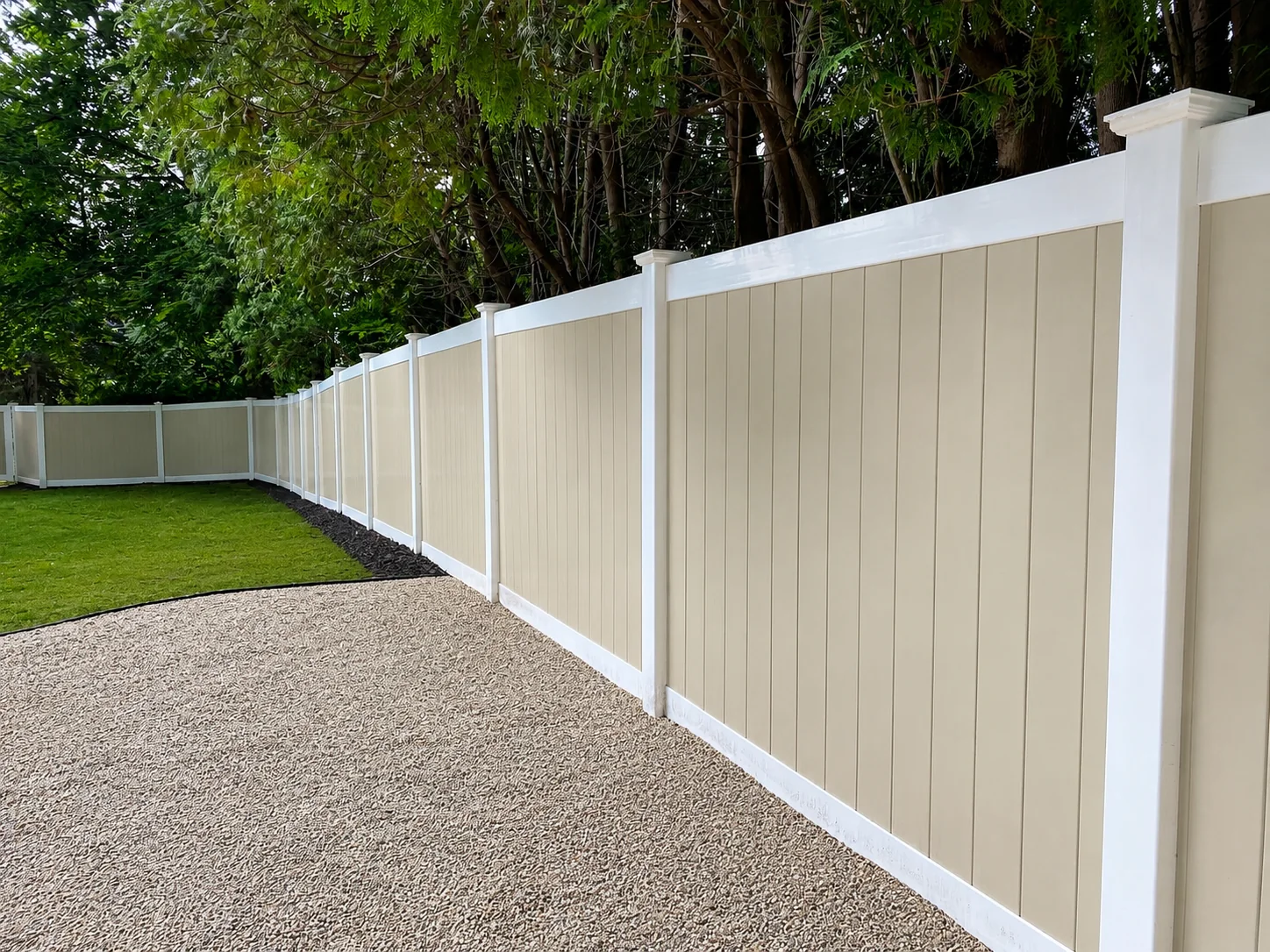
Vinyl privacy fencing can work in both settings on the same Chester County property. A lattice-top or picket-style vinyl design in the front yard satisfies an open-style requirement like the ones in West Goshen or East Goshen, while a solid vinyl privacy panel in the back yard, where height and solidity rules are usually more permissive, still delivers the fully private look homeowners often want. Our vinyl privacy fencing options page covers the range of styles available for exactly this kind of split approach.
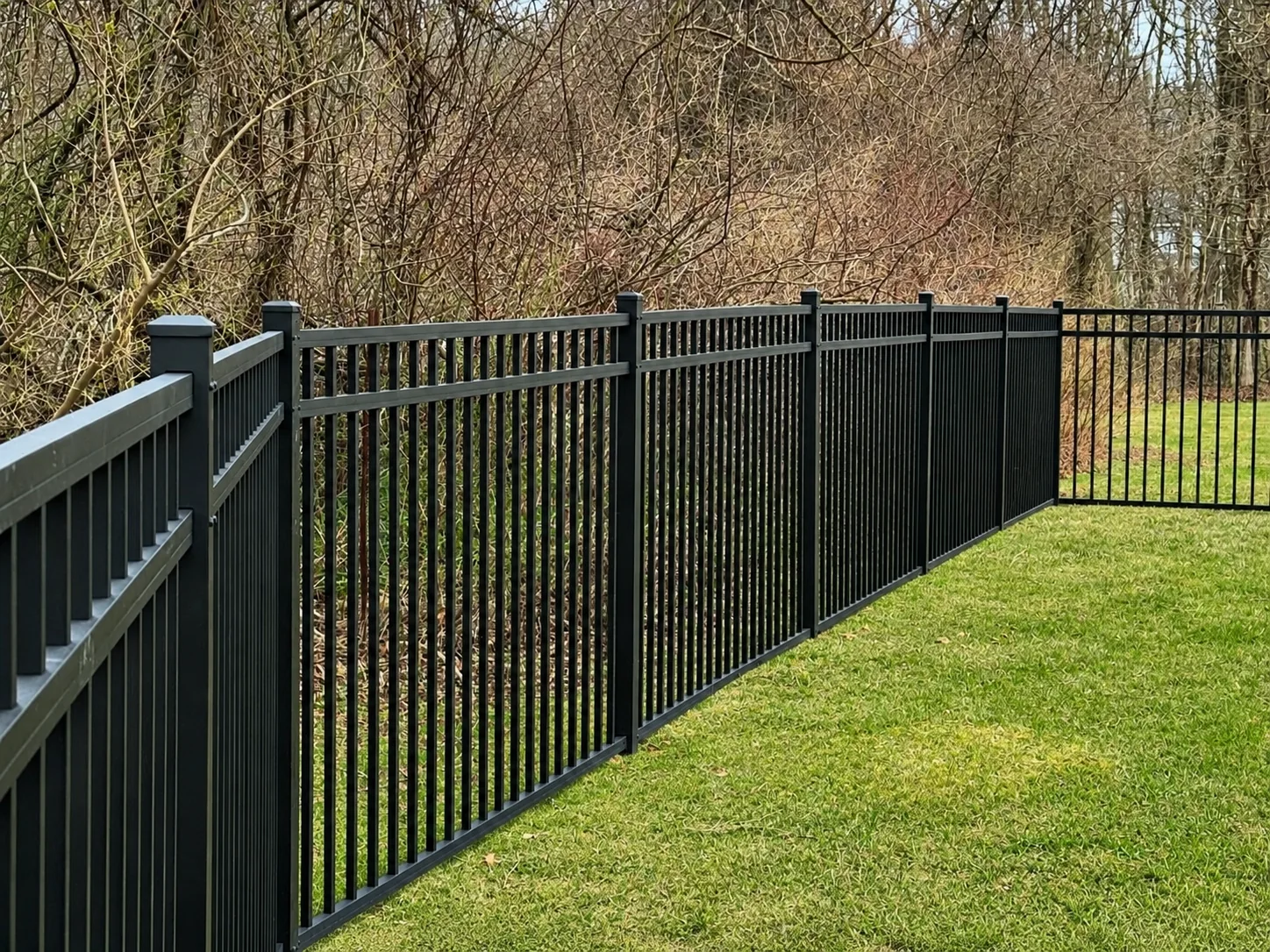
Aluminum fencing tends to be an open-picket style by design, which lines up well with both pool-barrier expectations and the front-yard rules several Chester County townships apply for a non-solid look. Because aluminum's vertical picket spacing is inherently open rather than solid, it's often a straightforward fit for the townships in this guide that restrict front-yard solidity, and it holds up well around a pool where a see-through barrier is generally preferred anyway. Powder-coated aluminum fencing is worth a look if you're balancing a township's front-yard rule against a pool barrier requirement on the same property.
Gate hardware deserves its own attention regardless of which material you choose, particularly around a pool. Self-latching and self-closing hardware is central to the pool barrier concepts described in Pennsylvania's adopted pool and spa code. Our matching gate installation options can be configured with that hardware from the start rather than retrofitted later.
None of this is a recommendation to pick a material based on price or preference alone. It's a matter of matching what a given township, or a pool barrier requirement, actually calls for, and confirming your choice against the specific ordinance for your municipality before finalizing a design.
Building a fence in Chester County without a required permit, or without HOA approval where one is needed, creates problems that tend to surface at the worst possible time. A township that discovers an unpermitted fence, whether through a neighbor complaint or a routine inspection, can issue a stop-work order on the spot, and in some cases require the fence to be modified or removed entirely to bring it into compliance.
Fines are also a real possibility, and they typically apply on top of whatever it costs to bring the fence up to code after the fact. That combination, fines plus rework, usually costs more than getting the permit right the first time would have.
The consequences aren't limited to the moment of construction, either. Unpermitted structures have a way of surfacing later, particularly during a home sale or refinance, when a title search or survey turns up a fence that was never permitted. That can complicate closing, delay a sale, or require the seller to resolve the permit issue before the transaction can move forward, sometimes years after the fence went up.
Getting a permit protects the investment in the fence itself, and it protects your ability to sell or refinance the property later without an old permitting gap becoming somebody's problem to untangle.
As this guide shows, fence rules in Chester County vary township by township, HOA approval often layers on top of whatever the municipality requires, and PA 811 notice has a strict window that has to be timed correctly before any digging starts.
Tri-State Fence & Deck handles the permit paperwork, HOA submissions, and 811 coordination on the customer's behalf, so the details covered in this guide don't fall on you to track down and manage one at a time. That includes figuring out which permit your specific township requires, preparing what an HOA architectural review board needs to see, and placing the 811 ticket within the legally required window before construction begins.
If you're planning a fence, gate, or Trex composite deck project and want the permitting and paperwork handled as part of the process, we serve Chester County homeowners. You can get a free Chester County estimate and start with a clear picture of what your specific township and any applicable HOA will require.
